
Hampshire and the Solent to be split into five councils
The government has today announced the local government reorganisation plans for the following areas in the Devolution Priority Programme: Greater Essex, Norfolk and Suffolk, and Hampshire and the Solent. Sussex and Brighton was also due to be decided today but the government has instead put forward an alternative proposal for consultation.
What is happening in Hampshire and the Solent?
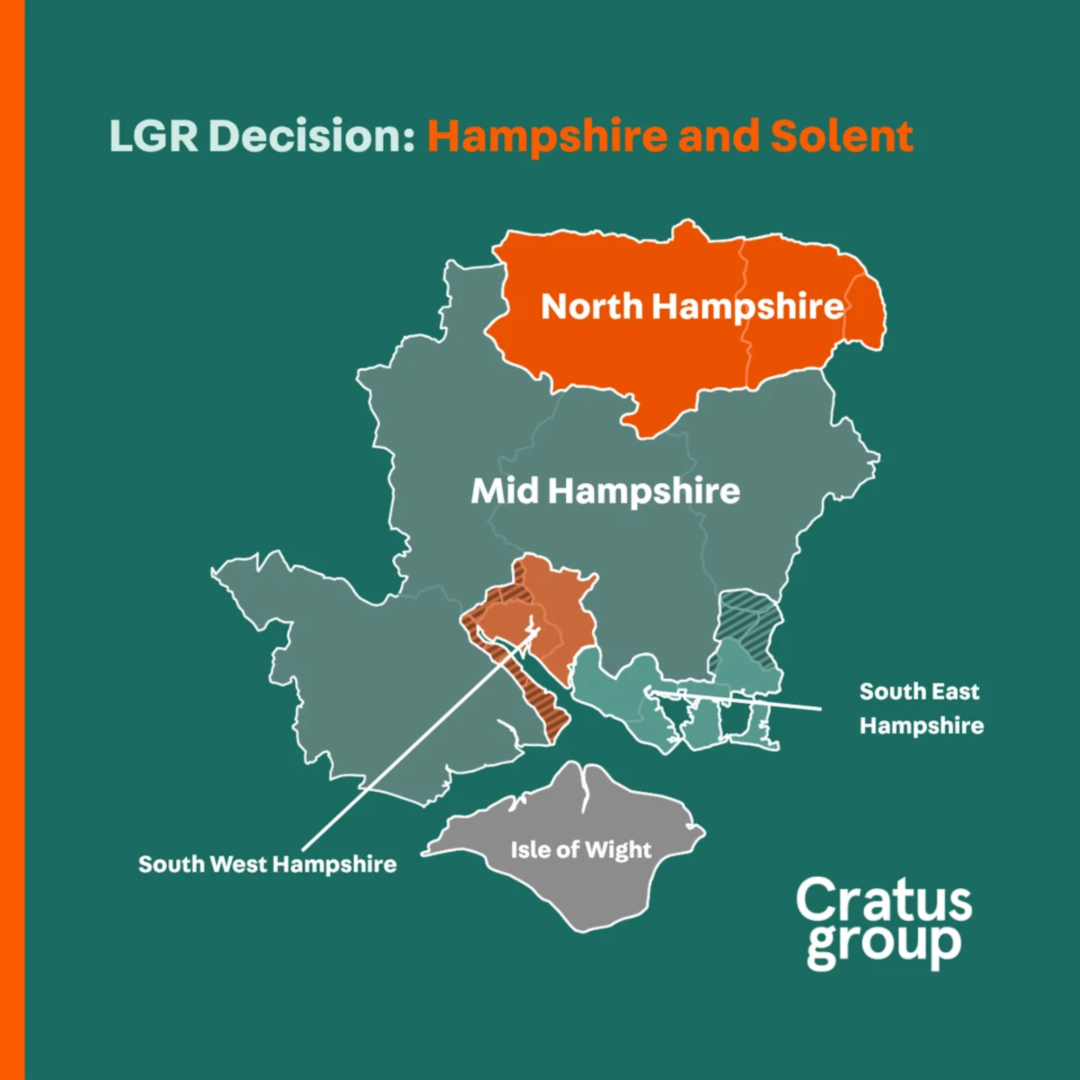
Hampshire and the Solent will be split into five unitary councils (including the Isle of Wight), replacing the current two-tier system of district and county councils. The five-council model was championed by seven of the 15 councils across the county.
The decision means that the Isle of Wight will retain its council boundaries, and four new councils will be established:
- North Hampshire Council (current local government areas of Basingstoke and Deane, Hart and Rushmoor)
- Mid Hampshire Council (current local government areas of East Hampshire, New
Forest, Test Valley and Winchester, less 11 parishes from all four areas) - South East Hampshire Council (current local government areas from East Hampshire, Fareham, Gosport, Havant, Portsmouth, three parishes from East Hampshire and one parish from Winchester)
- South West Hampshire Council (current local government areas of Eastleigh, four
parishes from New Forest, Southampton and three parishes from Test Valley)
The Secretary of State for Housing, Communities and Local Government, Steve Reed MP, reviewed separate proposals submitted by the county’s local authorities and said the five-area model best met the criteria. He explained that the government grouped urban and rural areas in a way that better reflects the local identities, communities, and places across the area, whilst also setting up new councils that would be more effective in supporting the growth of two of the key urban centres in the region: Portsmouth and Southampton.
Steve Reed MP added: “These changes will also facilitate a coherent geography for delivering public services, ensuring that vital functions – including social care, education, waste, and public health – operate within logical, place-based footprints.”
What’s next?
May’s local elections will continue as planned across Hampshire, where councillors on Hampshire County Council and Winchester City Council are up for election.
In May 2027, elections for the shadow authorities will take place, and the four new local authorities will become legal entities by April 2028. From this point, Hampshire’s current local authorities will be abolished and functions will be handed over to the new authorities.
Hampshire and Solent Mayoral Strategic Authority
Devolution continues to move at pace. Hampshire and the Solent will form a Mayoral Strategic Authority (MSA) that coordinates economic growth, transport, skills and other strategic matters, pending a devolution deal reached with central government.
The Mayor will be directly elected by the people of Hampshire and the Solent, and this election will take place in May 2028.
Cratus analysis
The government’s decision to proceed with the five-unitary model reflects a preference for a balanced geography aligned to Hampshire and the Solent’s mix of urban, rural and coastal communities.
Financial sustainability was a key driver, with ministers viewing this model as the most viable long term. It also strengthens Portsmouth and Southampton as economic anchors by expanding their boundaries, supporting housing delivery, infrastructure planning and growth.
More broadly, the decision points to a shift toward aligning council boundaries with functional economic areas and national priorities, particularly housebuilding. There is a clear (if unspoken) direction toward structuring authorities around urban centres, enabling expansion into surrounding suburban and rural areas.
However, smaller unitary authorities will have limited strategic capacity. As a result, more power is likely to sit with mayoral strategic authorities, particularly for long-term planning. This may also increase costs for services such as adult social care and children’s services, where disaggregation becomes more expensive.
The overall effect is likely to be reduced local democratic autonomy, with councils increasingly directed by mayors, and in turn by central government.
While not universally supported, backing from district and city councils, alongside organisations such as the Solent Growth Partnership, helped secure this model as the preferred option.
For further insight, or to discuss what this means for you, please get in touch.
What is local government reorganisation?
The government is streamlining local government through local government reorganisation (LGR), by abolishing the two-tier local government structure (district and county councils) and replacing it with a single tier of unitary authorities, meaning services are delivered by one council rather than two.
The government’s vision is that by 2029, all local authorities in England will be unitary authorities.