
Local Government Reform – What now?
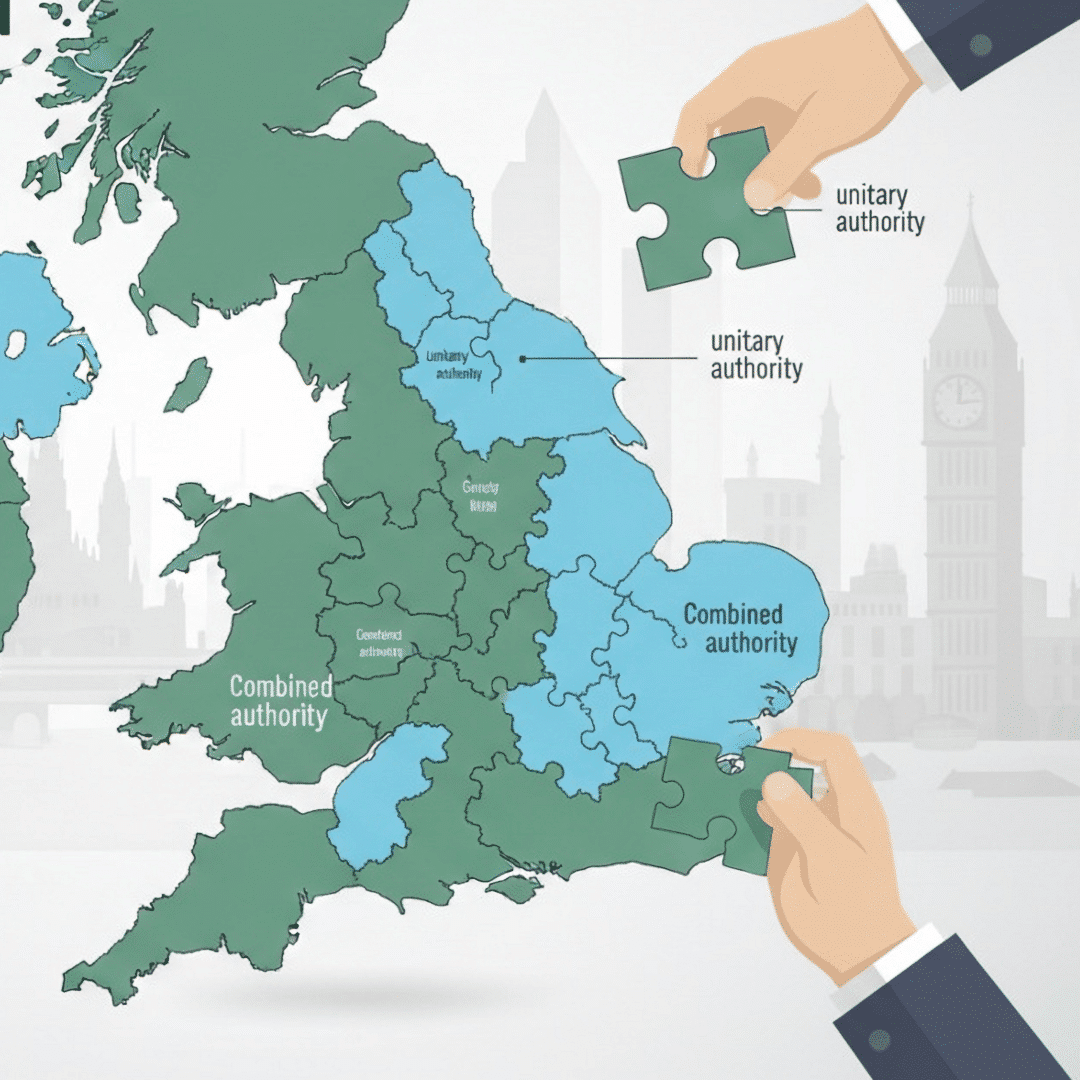
Local Government Reform (LGR) was promised as a means to further simplify local government in the areas that still had the two-tier system. As with previous rounds of reorganisation the aim was to make lines of accountability clearer, bring power closer to communities and boost growth. And of course, the Government hoped to put councils on a more sustainable footing / save costs.
Yesterday, returning MHCLG Secretary of State Angela Rayner put a pause on LGR to review the process and “make sure it is being done right” – having taken legal advice on the impending Judicial Reviews from various areas. But alongside the repeated phrase about making sure LGR is being done right, the Secretary of State acknowledged in a prolonged Q&A in the House of Commons that the pause would also be a chance to review LGR in the light of the new Labour administrations priorities.
That leaves a few issues to be addressed:
Does Andy Burnham really support LGR
It’s well known that Andy Burnham is a huge fan of Devolution, pushing more authority and funding to Combined Authorities to allow them to set their own priorities. This will continue and may even be speeded up. But what is less well known are his views on Local Government Reform.
In fact, he has expressed his support for LGR, saying that it is a “nettle that needs to be grasped” to consolidate funding and as a building block for devolution. But he has never been overtly passionate about it as he is with the creation of strategic mayoral authorities. He has also said he would re-look at some of the issues around LGR when challenged in public.
With many areas claiming the LGR boundaries are gerrymandered there may be scope for a further boundary review if continued pressure is put on the Prime Minister in the press, and there is possible for a more comprehensive pause.
Timetable
The pausing of the process and “rapid review” mean that the planned elections for new shadow authorities scheduled for May 2027 are now almost certainly off. If the review is a straightforward one on process, and simply to beat the JR, shadow authority elections could take place in May 2028, with new authorities taking control in April 2029 – dangerously close to the backstop date for a General Election for Andy Burnham.
If the review includes boundaries, the subject which has caused much of the angst, and that process becomes protracted and publicly contentious, the timetable could be stretched into the next Parliament.
One solution for the government could be to stage the process with some elections happening in May 2028 and others in 2029. This would resolve some of the capacity issues, allowing the government and those in the local councils delivering LGR some added time and resources without trying to force through every new council at the same time.
In the meantime, local elections will take place in May 2027 for existing authorities and it was gamely hinted that this could leave the door open for some shadow authority elections to take place if the process really is resolved quickly, but this seems unlikely.
Money
The Secretary of State has already reassured councils that their legal costs for the JR process will be refunded, which seems a tacit admission of the expectation of losing their case convincingly.
However, councils will not be given extra resource to cover all the costs of the LGR work to date on the basis that the work is not wasted and will be picked up in the future. Hard, but perhaps fair assuming that LGR will go ahead.
Perhaps more importantly, the Treasury will be looking closely at what it means for the cost of Local Government going forward. Already stripped back to the bone, LGR was intended to save yet more money from cash strapped Local Authorities. Many of those savings will have been factored into the long-term forecasts and will now create another headache for the Chancellor.
More immediately, many authorities were looking at LGR as a way to inject some cash or to share debt with their neighbours to get them out of their immediate financial difficulties. Without this get out of jail card, the Government may need to hand out some more bailout funding to avoid more authorities declaring Section 114.
Local Government morale
Local government has been working harder to do ever more, with less and less over the last decade and more, with budgets being consistently cut in favour of more glamorous priorities.
Most areas have faced several rounds of budget cuts and constant change. The LGR and parallel Devolution processes have been handled with limited additional funding and both programmes have been forced to take place at pace – only to be delayed.
Local Government, officers and councillors, can rightly feel ill-used. With councillors making up a big part of the campaigning machinery for political parties there is a question over their motivation to get out the vote, while senior officers may look at more years of uncertainty and chose to leave the public sector.
Transformation time
There is the possible benefit of having a bit more time. With the shortened timetable, many authorities were looking at simply scaling up their existing operations to take in new responsibilities, rather than considering what a completely new authority might look like. The optimists amongst us (including me) see the opportunity for that bit of extra time giving the opportunity for a bit more thought about what a new unitary could be and do for its residents.
So, the question of the fate of LGR starts with a pause to address the Judicial Review, but it could rapidly grow into a much bigger issues which sets the whole programme back by years. With Andy Burnham lukewarm about LGR, we may see progress slowed or put on the back burner for the next Parliament to avoid distractions.