

Under New Mancagement: Andy Burnham becomes Prime Minister and appoints a cabinet
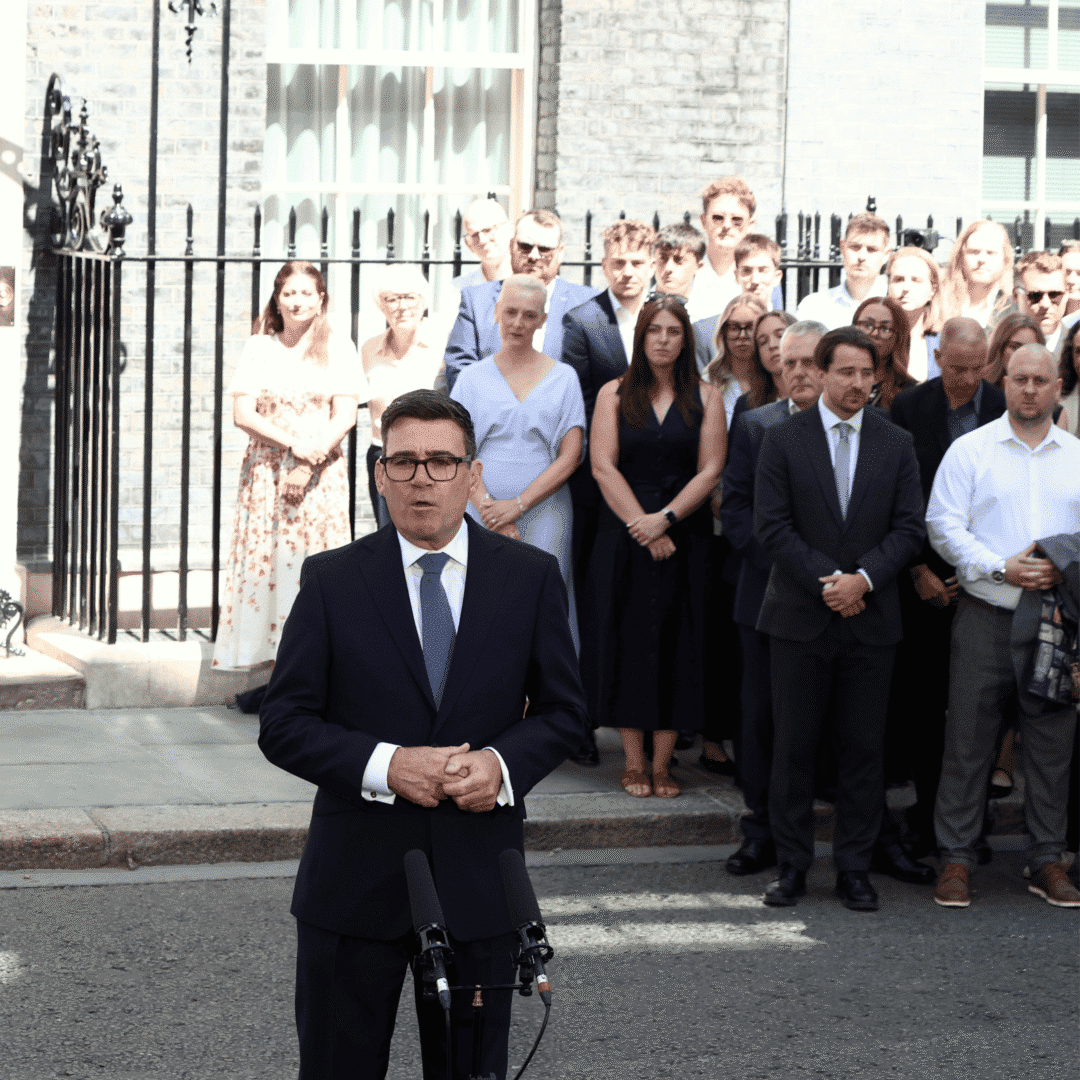
Yesterday, Andy Burnham became Prime Minister, after Sir Keir Starmer formally resigned and the King invited the new Labour leader to form a government. Speaking outside 10 Downing Street, Burnham acknowledged that he is Britain’s seventh Prime Minister since 2016 and promised to make the transition a “circuit breaker” after a decade of political instability.
His first speech was deliberately stripped back in its presentation. Speaking without a lectern, Burnham adopted a more natural and conversational style, acknowledging public frustration with politics and accepting that politicians had “not been good enough”.
The speech was fairly broad in its policy detail, but Burnham was clear that tackling homelessness would be his first priority in government. He said his first instruction as Prime Minister would be to begin work immediately to end rough sleeping, with the commitment backed by an additional £340 million over three years.
He also argued that political power had become too centralised, economic power too heavily privatised and large parts of the country neglected following deindustrialisation. In response, he promised greater devolution, stronger public control of essential services and greater use of public procurement to support British industry.
Burnham said he would publish a ten-year plan for Britain later in 2026. His other stated priorities included building more council homes, reforming education to help more young people into work, increasing mental health support and developing a more preventative approach to public services.
However, the Cabinet appointments announced later on provided a clearer indication of the political change Burnham intends to make. The reshuffle amounted to a substantial clear-out of ministers closely associated with Starmer and has widely been characterised as a purge of Starmerites.
Rachel Reeves, David Lammy, Steve Reed, Peter Kyle, Liz Kendall and Darren Jones were among those who left the Government. Burnham instead appointed Ed Miliband as Foreign Secretary and Louise Haigh as First Secretary of State and Chancellor of the Duchy of Lancaster, a senior role coordinating the delivery of the Government’s priorities across departments. Shabana Mahmood remained Home Secretary, while Wes Streeting moved to Defence and Yvette Cooper became Health Secretary.
The appointment of John Healey as Chancellor of the Exchequer was one of the biggest surprises. Most media speculation had focused on Shabana Mahmood and Ed Miliband as the leading candidates for the Treasury, with Healey receiving relatively little attention before his appointment.
Healey is a former Defence Secretary who resigned in June following a dispute with the Treasury over funding for the Defence Investment Plan. However, he also has significant experience of the Treasury, having served as Gordon Brown’s parliamentary private secretary before spending five years as Economic Secretary and Financial Secretary to the Treasury.
His appointment therefore places a minister who recently challenged the Treasury over spending in charge of the department itself. At the same time, Healey is one of the few Labour MPs with experience from the previous Labour government who has been associated with fiscal discipline, suggesting Burnham wants to pursue a more interventionist economic agenda without undermining confidence in the public finances.
It is not a complete rejection of everyone who served under Starmer, but the removal of so many figures identified with the previous administration represents a more decisive break than Burnham’s conciliatory Downing Street speech might have suggested.
Housing appears likely to be one of the new Government’s most prominent domestic priorities. Angela Rayner, one of Labour’s most senior and high-profile figures, has returned to government as Secretary of State for Housing, Communities and Local Government, having previously held the position between July 2024 and September 2025, when she was Deputy Prime Minister and Deputy Leader of the Labour Party. Matthew Pennycook will remain in his role in the department as Housing and Planning Minister and has been given the right to attend Cabinet, adds further weight to the housebuilding agenda
Taken alongside Burnham’s focus on rough sleeping, council housebuilding and the cost of temporary accommodation, these appointments suggest that housing policy will have a strong voice at the centre of government. Rayner will provide the political weight, while Pennycook’s continued role and Cabinet attendance should provide some continuity on planning reform and housing delivery.
Jonathan Reynolds has returned to the business brief, with most of the Department for Science, Innovation and Technology folded into an expanded department covering business, trade, science and innovation.
The new administration has also moved quickly on the cost of living. This morning, the Prime Minister and the Chancellor announced that VAT would be removed from domestic electricity bills from 1 October 2026. The Government estimates that the measure will save a typical household around £45 a year and cost approximately £850 million.
The Government said the measure would be paid for by cancelling the previous administration’s planned digital ID scheme and redirecting the savings. Scrapping digital ID is itself a significant reversal of Starmer-era policy and supports Burnham’s attempt to present his government as less centralising and more focused on immediate household pressures.
However, the announcement has already exposed tensions within Labour and demonstrated that the transition may not be entirely smooth. Darren Jones, who had responsibility for digital ID before leaving the Government in the reshuffle, publicly challenged the funding explanation. He argued that the digital ID programme had not itself been funded, meaning its cancellation would not automatically release money that could be spent elsewhere.
No 10’s position is that departments had been expected to identify savings from their existing budgets to fund digital ID and that this planned reprioritisation can now be directed towards the VAT cut instead. Nevertheless, Jones’s intervention has given Burnham an early argument over whether his first cost-of-living measure is genuinely funded.
The dispute matters because Burnham has recommitted himself to the previous Government’s fiscal rules and insisted that his programme will not involve taking risks with the economy. His ability to reconcile those constraints with promises on the cost of living, homelessness, council housing and social care is likely to be one of the central tests of his premiership.
Politically, Burnham is positioning his government to the left of the economic model pursued by successive administrations since the 1980s. His emphasis on council housing, stronger public control of essential services, reindustrialisation and devolution reflects the central themes of the “Manchesterism” agenda he developed as Mayor of Greater Manchester.
At the same time, the composition of his Cabinet is broader than the description of a straightforward move to the left might suggest. Healey is regarded as a relatively cautious appointment at the Treasury, Mahmood remains at the Home Office and several experienced figures from different parts of the Labour Party have retained or returned to senior positions.
The emerging picture is therefore of a government seeking a substantial change in domestic policy while attempting to maintain financial and international credibility. Burnham has cleared out many of the figures most closely associated with Starmer, restored allies and former ministers including Rayner and Haigh, and given housing an especially prominent place in his administration.
The first 24 hours have also revealed the potential difficulties ahead. The VAT announcement has demonstrated Burnham’s determination to act quickly on the cost of living, but the immediate challenge from Jones shows that former ministers removed in the reshuffle may be prepared to question the new Government’s decisions publicly.
Further detail will come with the appointment of junior ministers, with more announcements expected today and over the rest of the week. These appointments will help show how Burnham intends to divide responsibility for delivering the Government’s priorities across departments.
Attention will now turn to whether Burnham can maintain discipline within the Parliamentary Labour Party and provide credible funding for his wider programme. The return of Rayner, Pennycook’s attendance at Cabinet and the additional funding for rough sleeping leave little doubt that housing and homelessness will be central priorities. The early dispute over the VAT cut, however, shows that the tension between political ambition and the constraints of the public finances has already begun.