
We need to talk about LGR
Recently the headlines of British politics have been taken over by by-elections and the incoming new Prime Minister. An important issue seems to have sunken in the piles of information you get every day, which is local government reorganisation. Cratus Group is here to fish the topic up again.
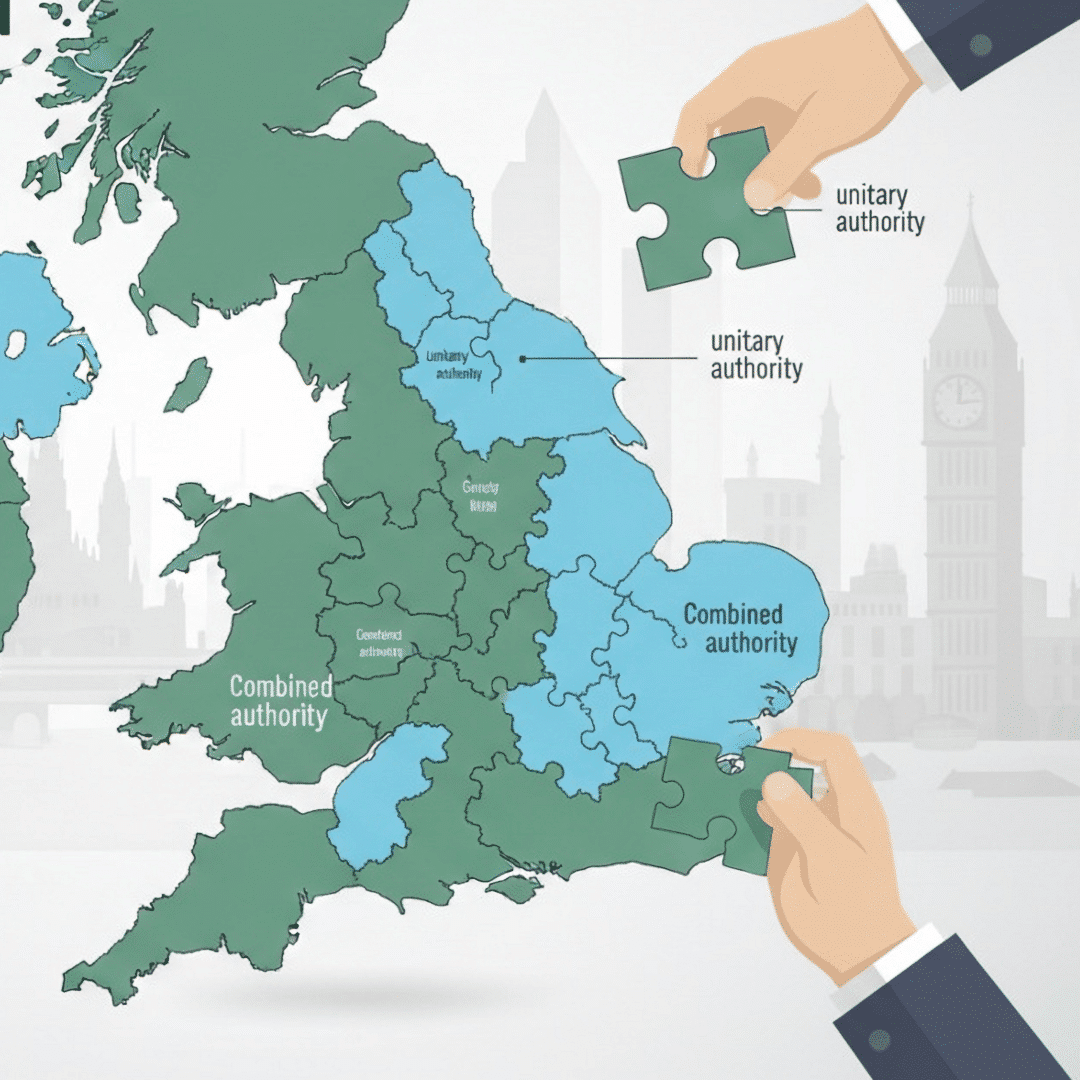
The proposed date for the second round of LGR decisions (commencing this week) is imminent. Supposing it goes ahead, we should be hearing the LGR minded-to decisions for the following areas:
- Cambridge, Peterborough and Huntingdonshire
- Devon, Plymouth and Torbay
- Derbyshire and Derby
- Gloucestershire
- Hertfordshire
- Kent and Medway
- Lancashire, Blackburn and Blackpool
- Leicestershire, Leicester and Rutland
- Lincolnshire, North Lincolnshire and North East Lincolnshire
- Nottinghamshire and Nottingham City
- Oxfordshire
- Warwickshire
- Worcestershire
- Staffordshire and Stoke-on-Trent
This is following the first round of decisions earlier this year in March, which contained Essex, Suffolk, Norfolk, and Hampshire. West Sussex, East Sussex, Brighton and Hove were supposed to receive its decision in March too, but the government has put forward an alternative proposal for consultation. There is no clear timeline when the local authorities in Sussex will receive its decision yet.
For most areas, following the minded-to decision, election for shadow authorities will be hosted in May 2027, and the new unitary authorities will be formally established in April 2028, except for Surrey, who received their decision in October 2025, and new authorities will be vested in April 2027. All existing upper and lower tier local authorities will be abolished by then.
It’s not too early to start preparing for it now
The move from two-tier local government to new unitary councils will involve far more than changing names, logos and committee structures. It will require new political relationships, new organisational cultures, new service models and new public-facing identities. Boundaries will be redrawn. Decision-making processes will change. Long-established local political dynamics will be disrupted.
In many places, council identity has been built up over decades. Residents understand who their council is, where it sits, what it does and how to access its services. LGR will challenge that familiarity.
That is why councils need to think carefully, and early, about identity. New authorities will need a clear sense of place that reflects all parts of their geography, and an identity that’s credible and inclusive to all areas of the council. Even where new boundaries are drawn around areas with shared economic, geographic or cultural links, some friction and uncertainty will be inevitable. This matters not only for residents, but also for economic development, tourism, investment, culture and civic pride.
There will also be a major political challenge. New councillors will be elected to shadow authorities and will need to establish a mandate, a governing narrative and a clear plan for both transition and onwards development. Leaders will need to show how they intend to bring organisations together, protect services, make difficult decisions and give residents confidence in the new arrangements.
The organisational challenge is equally significant. Council officers will be asked to deliver business as usual while helping to build entirely new institutions. Teams will need clarity on their future roles, structures and priorities. Frontline workers will need reassurance about what is changing and what is not. Residents will need to understand how they will access services, who will be responsible for them and whether standards will be maintained.
The most immediate task will, of course, be practical: ensuring that services continue to run smoothly. But communication cannot be treated as a secondary concern. In a period of uncertainty, silence creates space for anxiety, speculation and resistance. Councils will need to keep staff, members, partners and communities informed and engaged throughout the process, even when not every answer is available.
How Cratus can help
During periods of major change, strong leadership and clear communication become essential. Cratus can support councils, elected members, officers and businesses as they navigate this transition.
For elected members, we can help develop clear political narratives that define ambition, leadership and place. Early positioning will matter. Those who can articulate a confident vision for the new authority will be better placed to influence the transition, build alliances and provide reassurance to residents and partners.
For officers, we can support stakeholder engagement, internal communications and external messaging throughout the change process. This is not about simply issuing carefully worded press releases. It is about helping councils communicate honestly, consistently and constructively with the people affected by reform.
LGR is one of the biggest changes to local government in a generation. It will create disruption, but also opportunity. The councils and organisations that prepare early will be best placed to shape what comes next.
Over the coming weeks, Cratus Group will be publishing further insight on local government reorganisation, the forthcoming decisions and what they mean for councils, businesses and communities.
To discuss what LGR could mean for your organisation, please get in touch.